How prices are set
Published: 24.11.2025
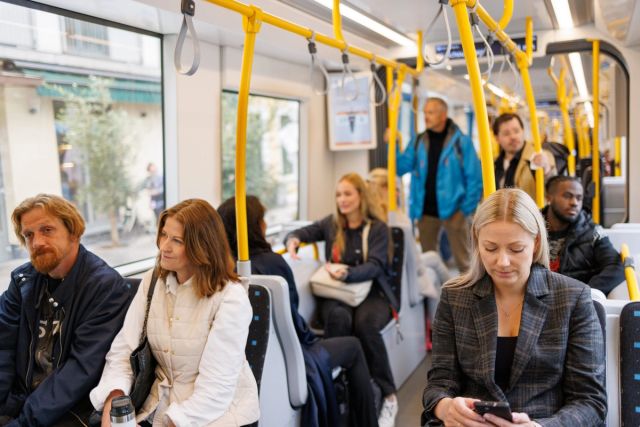
On the occasion of the annual ticket price adjustment, we have compiled questions and answers that we are often asked about ticket prices.
What happened to the ticket prices on January 25?
All ticket prices will be adjusted by 3.5%. This is the estimated increase for the municipal sector. From 25 January 2026, for example, a 30-day ticket will cost 805 kroner in Zone 1. For the other zones, the price of a 30-day ticket will be 1019 kroner for one zone. A single ticket in Zone 1 will increase from 44 kr to 46 kr.
Other useful information about the price change
- The REIS discountis continued throughout the entire Ruter area
- Children and young people still pay less than half the adult price
- The spouse discount (linked to the senior citizen ticket) is removed in line with national changes
- The control fee is adjusted to NOK 1,250 (payment on the spot) and NOK 1,530 (invoice)
Who decides the ticket prices for Ruter?
Ticket prices are determined by the City Government for Environment and Transport in the City of Oslo and the County Council for Transport in Akershus County.
Ruter adjusts ticket prices in line with price growth in society, but it is the elected officials who make the final decision on what the actual price will be.
What is decided politically and what does Ruter decide?
Politically determined: The price level, discount schemes, zone division, and overarching principles for ticket pricing.
Ruter decides:Handles practical implementation, technical solutions, and product design within the political framework, and provides professional recommendations.
How are ticket prices determined?
This is a political process in which Ruter prepares proposals based on cost developments in society, traffic growth, and political guidelines. The proposal is then sent for political consideration in the county authorities and the City of Oslo, which adopt the prices, usually in connection with the budget process.
How often do ticket prices change?
We change the prices on the third Sunday of the year, every year. In 2026 this is Sunday, January 25.
There may also be other price adjustments in addition to the regular one in January, but those are decided by the politicians.
What does the annual price increase involve?
The basis for the annual price adjustment is the Consumer Price Index (CPI). This is intended to cover increased operating costs such as wages, energy, maintenance, and inflation. In 2025 this price increase was 3.5% and forms the basis for the price adjustment on January 25.
Are the prices adjusted several times a year?
You may have read that the city council in Oslo wants to reduce the price of the monthly travel card in Oslo – so why are prices going up?
The price change taking place on January 25 is a regular annual price adjustment, where prices are increased in line with cost developments in society. In addition to this, there may be other price changes in 2026, but it has not been determined when these changes might take effect. It is up to the politicians to reach an agreement on that.
Does Ruter profit from the ticket prices being changed?
No, Ruter is a non-commercial company owned by Akershus County Council and Oslo Municipality. Ruter does not make a profit from ticket revenues, and all income is reinvested in public transport services. By travelling by public transport, you are therefore helping to finance future public transport. Annual price adjustments are necessary to cover rising costs in society and to maintain the public transport services in the region.
What proportion of Ruter’s revenues comes from ticket sales?
Typically, ticket revenues cover around half of the operating costs. The rest is financed by public funds from the Oslo municipality and Akershus county council.
How much is public transport subsidized by the government?
About half of the operating costs are covered by public subsidies. In addition, there are investments in infrastructure (metro, tram, bus terminals), which are largely publicly funded.
How are the costs divided between ticket revenues and public funding?
The distribution varies somewhat from year to year, but the goal is a balance where users pay a reasonable share while society subsidizes the rest to keep prices affordable and encourage the use of public transport.
Why does it cost money to use public transport?
Even though the ticket may seem expensive, driving your own car is often more costly when you factor in all the expenses such as insurance, maintenance, fuel, parking, and tolls.
It is important to remember that public transport requires large investments: purchasing vehicles and new infrastructure, personnel salary costs, and continuous maintenance and operation of an extensive route network. That is why public transport is also expensive to run.
An example of why public transport is expensive is that in Oslo we have bus routes that run every four to five minutes during the busiest hours. Routes 20, 21 and 37 are examples of bus lines with the most frequent departures during rush hour in Oslo. Trams 17 and 18 run every five minutes.
If you still feel that the tickets are expensive, it might be good to remember that public transport is an important public service that gives everyone the opportunity to travel together, no matter who you are or where you come from. In addition, it brings many environmental benefits, reduces traffic congestion, creates more space for people in the region, and provides cleaner air.