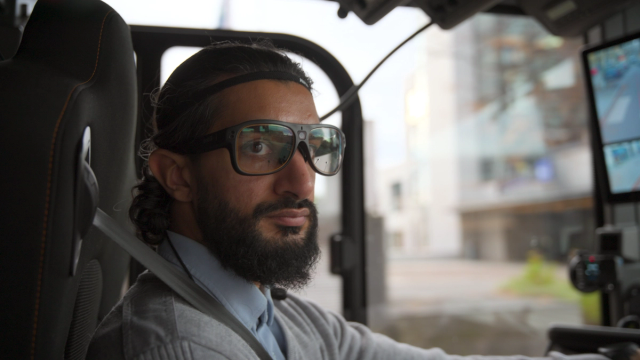
Easy being a bus driver? We let scientists follow a driver on Oslo's toughest route
This is how we conducted the test
Summary
There is a great need for bus drivers, both in Norway and in Oslo and Akershus. At the same time, 1 in 10 people in the population say they do not perceive the bus driver profession as attractive. Therefore, Ruter and research institute SINTEF have collaborated to show how demanding it is to drive a bus. "The test" was conducted by having a bus driver, instructor and bus driver Ayyaz Ali, drive the 37 bus in Oslo from Helsfyr to Nydalen. The SINTEF researchers equipped Ali with special glasses to measure how he used his gaze while driving, in addition to a heart rate monitor.
– There are not many professions that can compare with the bus driver when it comes to the demands for concentration and anticipating what will happen in the next moment, says researcher Dagfinn Moe at SINTEF.
In Oslo and Akershus, it is Ruter that administers public transport, while various bus companies operate on behalf of Ruter. But for us to deliver a good bus service together in the future, the industry needs more bus drivers.
Many more.
It doesn't help that only 1 in 10 people in the population view the job as attractive, according to a survey (NHO Transport, 2023). Many people think the job as a bus driver is monotonous and boring. Is that really what it's like to be a bus driver?

– This is not what bus drivers experience and see. And at Ruter we believe it doesn't come across how demanding it is to transport people safely and comfortably. It's rather the opposite: Bus drivers have a great responsibility for passengers, and must deal with many different elements in traffic. It also provides a lot of mastery, says Runa Jacobsen Roald, project manager at Ruter.
Science project on buss 37
To disprove the impressions about the bus driver profession, Ruter has collaborated with SINTEF on a unique research project:
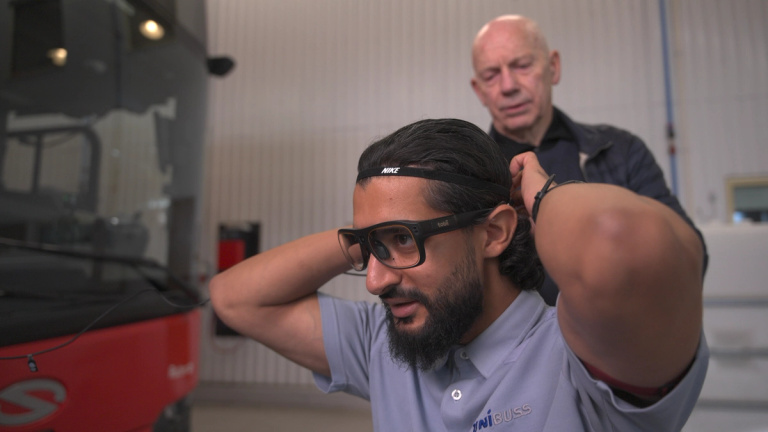
Bus driver and instructor Ayyaz Ahli was equipped with a heart rate monitor and eye tracking glasses. From Helsfyr in the east to Nydalen in the northwest of Oslo, the 37 bus drives one of the capital's most demanding routes. The reason is that the route goes through major hubs and heavy traffic, especially in the center of Oslo.
Using some very special glasses, the researchers measured all eye movements during the drive, which took just under an hour.
The researchers' goal was to show how the bus driver uses their gaze to drive in complex traffic situations. At the same time, they measured the driver's stress level with a heart rate monitor. The research is a continuation of the work SINTEF has done with bus drivers in Trondheim.
Suprising results
What did we find? During a 55-minute trip on the 37 bus in Oslo, the researchers registered thousands of small gaze changes in bus driver Ayyaz Ali. And the data reveals an impressive performance:
At most, Ayyaz shifted his gaze as much as 2.5 times per second (!). The figure illustrates how bus drivers must constantly manage challenges and stay ahead.
What does the bus driver himself think about the 'experiment'?
– Now I'm excited. Did I fail? jokes Ayyaz – well aware that the trip went well.
The researchers fixated on one particular aspect of the driving: how he always planned the next move.
– If I'm at a bus stop, I try to think about the next stop. What does the pattern look like to me then, what situations. I always try to be one step ahead, says Ali.
The bus industry's Martin Ødegaard?
The bus driving profession is not for just anyone. Researchers from SINTEF draw parallels from other professions to describe how a bus driver actually works in traffic.
– A pilot has one take-off and landing, while a bus driver might have 30-40 take-offs and landings during a single route. That doesn't mean that being a pilot isn't difficult, but it illustrates how vigilant a bus driver must be, all the time, says Moe.
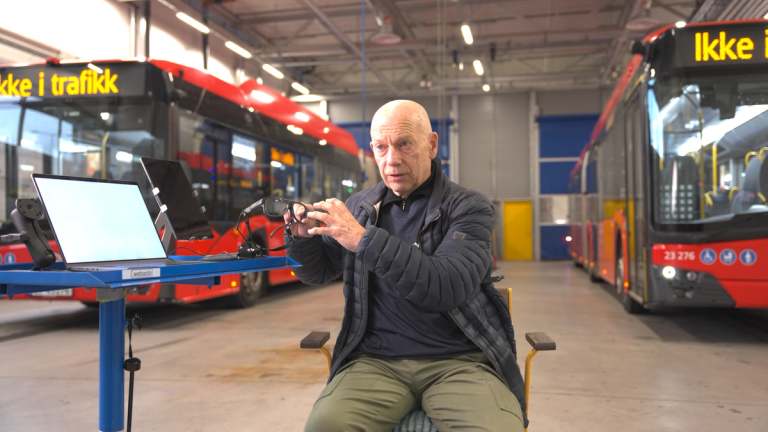
Technology to reveal how people "scan" their surroundings has also been used in sports. And one of the most well-known examples is from Norway.
– Martin Ødegaard has received attention from research communities because of his specialized skills. He uses his head constantly to orient himself and to plan the next move. In principle, it's the same for a bus driver – except that it's more critical in terms of safety, says Moe.
– The same applies to cyclists in the Tour de France, who must stay oriented in large cycling pelotons.
– Bus drivers have a demanding job, as an operator and as a navigator in traffic. I hope people can open their eyes to the work bus drivers put in, every day.
Becoming a bus driver: Questions and answers
How do I become a bus driver?
There are several paths to becoming a bus driver. Some different ways are:
Take the education yourself:
- You can complete the entire education at an approved traffic school. Once you have completed the education, you can apply for a position at one of the bus companies that operate for Ruter.
- The bus companies that operate for Ruter are Nobina, Unibuss, Vy and Connect bus, and you can check their websites for available positions.
- Financial support: if you take the driver's license on your own, you can apply to Lånekassen (the Norwegian State Educational Loan Fund) and receive student loans and grants.
Support for retraining/education:
- NAV can in some cases provide support for education. This can be granted and carried out individually, but by joining a qualification program, NAV usually has agreements with bus companies regarding employment: Qualification for the bus driver profession - nav.no
- Some of our bus companies can offer their own training programs. They then cover the cost of the driver's license in exchange for a commitment period with the company (e.g. 2 years). Contact the bus companies to inquire if they have this option.
- Some upper secondary schools offer free training in bus driving, where you can apply for a place. One such place is, for example, Hønefoss VGS: Professional driver - Hønefoss upper secondary school
Apprenticeship scheme:
- What is common is to attend VG1 technology subjects, VG2 transport and logistics, and then apply for an apprenticeship position at a bus company.
- This is a good way to get your driver's license if you are under 24 years old, as you are "typically" between 18-23 years old at the start of the apprenticeship period. But it is fully possible to do it when you are 24 years old and older as well.
- As an apprentice, you have two years of practical training at the bus company, where you have your driving test at the end of the apprenticeship period. You receive apprentice wages (this is a fraction of the base salary, which often increases throughout the apprenticeship period, e.g. 30% of the annual salary the first six months, then 40%, 50%, and finally 80% the last six months)
- Adults over 23 years old who do not have formal vocational education can follow an adapted training plan. This often includes short courses and practical training. Contact the training office, and they will assess in each individual case what opportunities there are for an apprenticeship position in one of their member companies/bus companies: Become an apprentice – The Training Office for Service and Transport SA
- You receive a trade certificate upon completion of the apprenticeship period, which means you get a base salary that is NOK 27,384 per year above the "regular" salary.
- Become an apprentice – The Training Office for Service and Transport SA
What are the qualifications to be a bus driver?
The requirements for the driving test are that you:
- are over 24 years old,
- have a driver's license class B,
- and can speak Norwegian well enough (level B1 or bussnorsktesten)
Otherwise, the most important thing is that you enjoy driving and feel confident doing it.
Liking contact with people is also important, because as a driver you meet many people every day.
It is a profession where you get to be practical. You get out, see the city and meet people. If you don't want to sit in an office, the bus driver profession can be a good choice for you.
As a bus driver, you also have shift work (varying working hours – morning, midday, evening, night and weekends), so this is something you must be comfortable with.
Does this apply to you? Then you can train to become a driver.
To drive a bus and earn money you need to have:
- Driver's license class D, which you obtain by passing a theoretical test ("theory test") and a practical test ("driving test").
- Professional driver competence "CPC" (Certificate of Professional Competence), which you obtain by completing a 140-hour course and then passing a theoretical test.
- Driving permit (kjøreseddel), which you apply for from the police, requires that you have a clean record for the past 4 years and a Norwegian health certificate.
What does it cost to become a bus driver?
The costs vary, but if you take it at a traffic school, it will typically cost around NOK 100,000 - 120,000.
You can apply for support from Lånekassen (the Norwegian State Educational Loan Fund) to receive student loans and grants.
There are also opportunities to get free education through adult education/upper secondary school, but then there are limited study places, as well as a set study program, whereas it will be more flexible to take it on your own.
How much do you make as a bus driver?
In Ruter's area, you work either 34 hours (Oslo) or 35.5 hours (Akershus) per week. Most jobs have 37.5 or 40 hours, so you work fewer hours per week as a bus driver.
Starting salary
The base salary is just under 500,000 NOK for a newly educated driver. In addition to the base salary, one receives various supplements for working evenings, nights, weekends, and public holidays. Therefore, as a 'new bus driver', one often earns well over 500,000 NOK a year.
Wage development
In addition to annual salary adjustments, your pay increases based on your length of employment (seniority). You can also choose to take a knowledge module and to obtain a professional certificate, which further increases your salary.
- Seniority: You move up a pay grade every 3 years, up to 9+ years. Each pay grade increases your salary by just under 10,000 NOK per year.
- Knowledge module: You can take an in-house company module (module 4). This will result in an annual increase of just under 6000 NOK.
- Certificate of Apprenticeship: having a certificate of apprenticeship increases your salary by approximately 27,000 NOK per year. You can obtain a certificate of apprenticeship after 5 years of professional driving experience. If you get your driver's license as an apprentice, you automatically receive a certificate of apprenticeship.
Annual salary adjustments
The bus driving profession has collectively bargained wage and working conditions.
It means that unions negotiate for better wages on your behalf. This happens every year.
In addition, the entire collective agreement is negotiated every other year. At that time, negotiations take place on other working conditions, such as pension, working hours, and vacation.
You can find the pay scales here.
- Base salary for a newly graduated driver: look at 0-3 years of seniority and 3 modules, without a professional certificate. This is because one obtains 3 modules through YSK which is a mandatory part of the education.
You can find the Bus Industry Agreement here.
- Here you can read more about, among other things, working hours, rest periods, and allowances for inconvenience and overtime:
Other benefits:
As a permanent employee at Ruter's area, you also get heavily discounted public transport tickets on all modes of transportation (except for trains) for you and your family (partner and children).
How long does it take to become a bus driver?
It will vary depending on how many driving lessons you need and how intensively you take them, as well as how quickly you work through the theoretical material.
However, there are some mandatory hours of instruction, driving lessons, and courses, which often means it takes 3-4 months.
Furthermore, potential failures can affect the amount of time it takes, as there is a required waiting period before one can retake the exam:
- Failed the theory test, 1 week waiting period
- Failed driving test: 4 weeks waiting period
- Strike at YSK: 2 weeks waiting time
Additionally, there will be some waiting time when you apply for a taxi license at the police station. You must have a class D driver's license to apply, so we recommend applying as soon as you have passed the driving test.
You can find tips here on how to avoid an incomplete application.
What is the workday like for a bus driver?
Being a bus driver is a fun, exciting, challenging, and important job.
Driving a bus is a fun and challenging job that provides a great sense of accomplishment. Driving a bus in and around Oslo requires precision and planning. There are new traffic situations and challenges every day.
In addition, you have a lot of freedom - it's just you and the bus. With this freedom also comes responsibility and demands – from schedules to road safety, and the responsibility for the lives of the people you transport.
It's a varied workday where you meet many different people. You also have many, different, and good colleagues – whom you meet while out driving, and at the bus depot or "bus garage”.
A bus driver has an important job for the entire community – one we cannot do without.
How secure is the job of a bus driver?
Job security as a driver is very good. There is a high demand for drivers, and the demand is stable: people need to travel!
It's a profession that is critical to society, and the bus service must be maintained. This became evident during the corona pandemic: many professions had a large number of furloughed employees. However, the regular bus service continued, and so did the jobs for the bus drivers.
It is also a job with opportunities for career development if one desires it. There are several roles within the bus companies that require experience as a bus driver – for example, training instructor, traffic manager, and operations coordinator.