Night-time metro: Here are the lessons from the pilot project
Published: 09.04.2026
Last updated: 13.04.2026, 16:00
Customers satisfied
The tests were carried out during the night before Sundays on behalf of the Oslo Municipality’s Department of Environment and Transport, following a decision by the Oslo City Council.
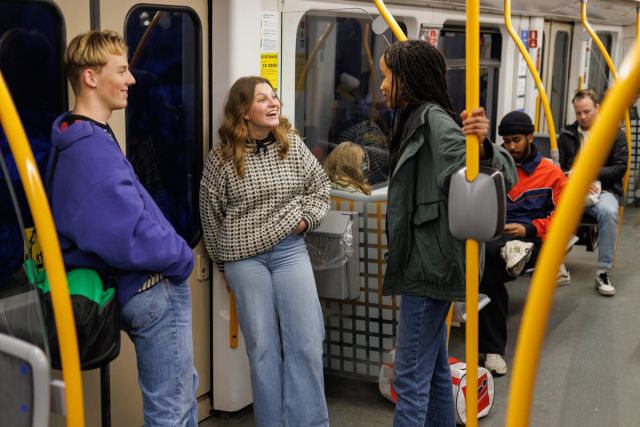
The feedback from travelers was positive. A digital survey showed that as many as 95 percent of those who had used both the night metro and the night bus felt that the metro service was better. Customers particularly highlighted better punctuality, shorter travel time, more frequent departures, less crowding, and a safer travel experience as advantages of the metro.
There were also roughly twice as many boardings per night on the night-time metro as on the corresponding night bus routes in 2024.
Nevertheless, the conclusion is clear: a night-time metro service is an expensive offering that does not correspond to the actual need.
Evalueringsrapport: Test av nattåpen T bane(PDF)
Subway much more expensive to operate than night bus
During the trial, running the metro all night cost about NOK 173,000 per night. Taking into account the experience from the test period, the cost estimate for a permanent arrangement should be revised upwards to around NOK 212,000 per night.
For comparison, operating the night bus on the same routes (lines 2N and 3N) costs a total of about NOK 22,000 per night.
So the metro had twice as many boardings as the night buses – but at almost eight times the cost.
Half-full subway
The metro can transport large numbers of passengers. During the test, the metro ran all night with significantly more capacity than needed: the busiest departures were no more than 51 percent full.
By comparison, the night bus 2N was on average 65 percent full, and the busiest departures had an occupancy rate of around 83 percent.
Based on the evaluation, Ruter’s assessment is that it is more appropriate to use resources to improve the night bus service than to continue night-time operation of the metro.